The Fracture of the Image
The photographic image is often perceived as a coherent and stable surface. Yet this apparent unity conceals internal tensions linked to the very conditions of its production.
In Alice Odilon’s research, the image is approached as a field of forces where perception, construction, and interpretation intersect. Moments of fracture reveal the invisible mechanisms that organize representation.
The texts gathered in this axis examine the forms of rupture that appear within the image: shifts, fragmentations, or perceptual ambiguities.
These fractures open a critical space in which the image ceases to be a simple visual object and becomes a site for analyzing the structures of the visible.
Everything That Cannot Be Seen Is Real
13 May 2026
It begins with a family fused into an undifferentiated mass. They are all the same. They do not communicate. Conflict is avoided in order to preserve the illusion of unity. Violence therefore circulates elsewhere. It shifts toward the anorexic subject.
The symptom becomes the place where the family deposits everything it refuses to see. The person with anorexia becomes the necessary scapegoat for the survival of the system. The family remains frozen inside an emotional anesthesia. Time no longer moves.
I also suspend time through the symptom. NO FUTURE. The person with anorexia is Punk. I attempt to create a boundary within the familial magma. I differentiate myself through refusal. Through disappearance.
My body becomes a territory of absolute control. A desperate attempt to produce stable limits around a self experienced as weak or permeable. But something fractures. I think outside of my body. I no longer fully inhabit this suspended matter. I am an embodied soul with a disembodied burden.
The body becomes an external object. Demanding. Invasive. Almost hostile. “I am more than my body” slowly becomes “I am not my body.”
Then a new contemporary figure emerges: the algorithmic self-model. The ghost generated by AI. A synthetic image capable of producing a version of the subject more coherent, more stable, more acceptable than lived reality itself.
I become trapped inside this representation. AI produces a double that gradually replaces embodied experience. I can no longer escape the image. My body is me. Or there is no one there. The subject becomes a simulation of itself.
To inhabit a body requires accepting the world. Danger. Desire. The gaze of others. It requires accepting aliveness itself. But I exist elsewhere. I experience an internal signal without language. An anxiety preceding speech. An archaic warning I cannot name. Because I am no longer connected to my body. The body is suspended. Muted. Dissociated.
Then another device emerges: the self-portrait. I invent my own physical experience. Photography becomes a temporary return to embodiment. I must pose. Hold a position. Endure coldness. Discomfort. Nudity. Imbalance. The body becomes sensation again.
Then the image appears. Photography operates as material evidence. It reveals the trace of the body. Its presence. Its undeniable appearance. The photographs return me to the physical experience of the moment they were taken. They force me to acknowledge that a body was there. Even if that body still feels foreign.
Thus, the self-portrait becomes an attempt at temporary reincarnation. Not a cure. But a fragile negotiation between myself and my own disappearance. Even if I remain anorexic, I have inhabited my body during the photographic act.
Despair: A Weapon Against Neutrality
21 December 2025
This series confronts the sanitized, neutralized art world by weaponizing despair — portraying the rawness of human experience as a critique of indifference. It interrogates complicity, commercialism, and the erasure of trauma in contemporary visual culture. The series is a manifesto: the viewer cannot remain neutral.
Despair fractures identity. These works confront the viewer with vulnerability as resistance, revealing what the art world often prefers to erase: rupture, decay, and the unfiltered weight of memory.
Fracture is the gaze interrupted; Erosion is the residue of what is left behind when neutrality fails. The body, the surface, the very light — all carry testimony.
The Mask Refuses this World
26 November 2025
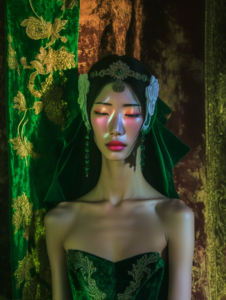
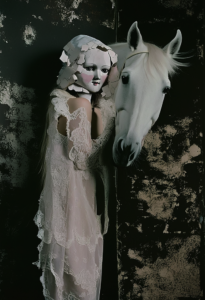
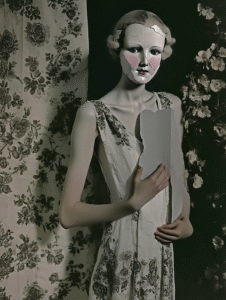
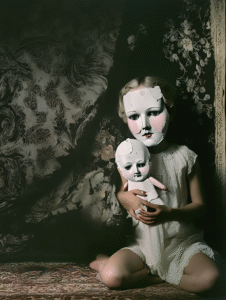
In this new series, I advance my long-term investigation into the fractures of selfhood by introducing a masked figure whose porcelain stillness becomes a site of resistance.
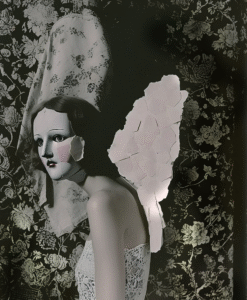
The mask—rigid, fragile, and deliberately unalive—interrupts the Western obsession with the expressive face.
It rejects the algorithmic hunger for legible identity, for neatly categorized emotions, for the relentless circulation of “selves” demanded by contemporary platforms.
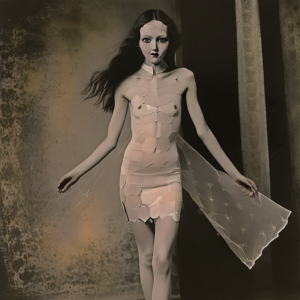
Drawing on the critical legacy of Hans Bellmer’s deconstructed dolls and Annette Messager’s strategies of disguise, I position the mask not as concealment but as refusal.
These figures do not “perform” for the viewer. They withhold. They fracture.
They confront the violence of a culture that has replaced empathy with replication, individuality with templated personas, and intimacy with the cold efficiency of social metrics.
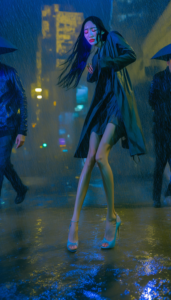
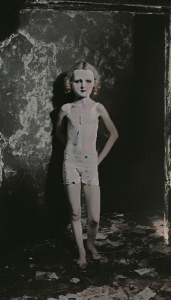
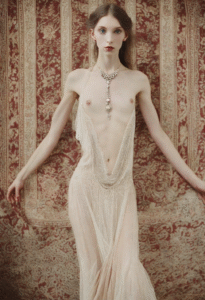
My research on identity, trauma, anorexia, and the politics of the gaze resonates throughout the work: the bodies, elongated or rigid, stand at the threshold between vulnerability and effacement.
They recall how contemporary image economies clone faces, behaviours, and desires, producing a world where sameness is rewarded and complexity punished. Here, the mask becomes a counter-gesture—a shield against the algorithmic demand to be readable, desirable, “engageable.”
My imagery points toward a post-human condition in which the body becomes a contested territory.
The floral backdrops, torn paper textures, and staged ruins evoke the collapse of domesticity and the dissolution of memory.
These scenes echo a society that has normalized emotional detachment, where materialism functions as an anesthetic and empathy becomes the rarest commodity.
What emerges is an uncompromising visual language: subversive, tender, and fiercely intelligent. I refuse the sentimental.
I offer instead a radical quietness—an opaque identity that society cannot decode, commodify, or consume.
The work insists on the right to opacity, to complexity, to being untranslatable in a culture addicted to likeness.